
NAMES
TAXONOMY
El Salvador
Issued:
Stamp:
Heliconius charithonia
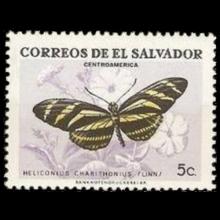
El Salvador
Issued:
Stamp:
Heliconius charithonia
El Salvador
Issued:
Stamp:
Heliconius charithonia
Heliconius charithonia (Zebra longwing) is distributed across South and Central America and as far north as southern Texas and peninsular Florida.
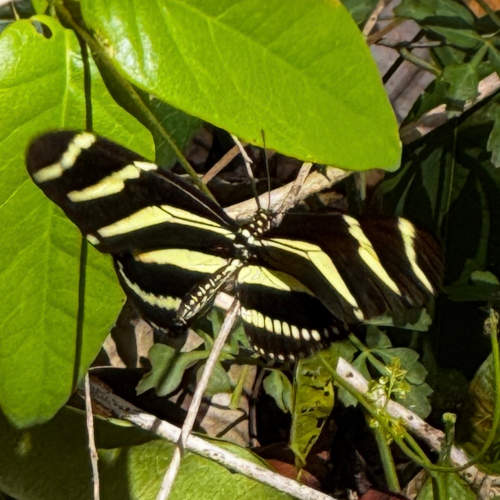
Genus species (Animalia): Heliconius charithonia
Heliconius charithonia, the zebra longwing or zebra heliconian, is a species of butterfly belonging to the subfamily Heliconiinae of the family Nymphalidae. It was first described by Carl Linnaeus in his 1767 12th edition of Systema Naturae. The boldly striped black and white wing pattern is aposematic, warning off predators. It is the state butterfly of Florida.
The species is distributed across South and Central America and as far north as southern Texas and peninsular Florida; there are migrations north into other American states in the warmer months.
Zebra longwing adults roost communally at night in groups of up to 60 adults for safety from predators. The adult butterflies are unusual in feeding on pollen as well as on nectar; the pollen enables them to synthesize cyanogenic glycosides that make their bodies toxic to potential predators. Caterpillars feed on various species of passionflower, evading the plants' defensive trichomes by biting them off or laying silk mats over them.
The zebra longwing, Heliconius charithonia (Linnaeus), was designated the state butterfly of Florida in 1996.
Description The caterpillars are white with black spots and have numerous black spikes along their body. Adult butterflies are monomorphic of medium size with long wings. On the dorsal side, the wings are black with narrow white and yellow stripes, with a similar pattern on the ventral side, but paler and with red spots. The wingspan ranges from 72 to 100 mm.
Distribution and Habitat
H. charithonia is found in South America, Central America, the West Indies, Mexico, and the Southeastern United States. Adults sometimes migrate north to New Mexico, South Carolina, and Nebraska during the warmer months. The geographic distribution of H. charithonia overlaps with the ranges of other butterflies which sometimes leads to conflict. For example, the ranges of H. charithonia and the gulf fritillary (Dione vanillae) overlap; in some cases, gulf fritillaries can sometimes be subjected to competition and fighting from Heliconius charithonia vazquezae when those species have breeding populations in similar areas and within the same geographic range. It was declared the official butterfly for the state of Florida in the United States in 1996. The species frequents tropical hammocks, moist forests, edges, or fields.
Reference: Wikipedia.com
Photos: P. Needle