
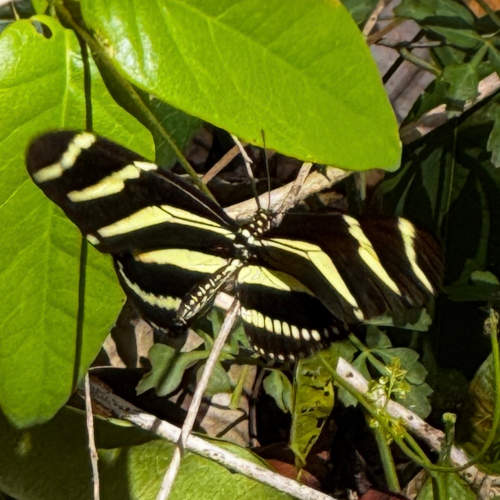
Heliconius charithonia
Common name:
Zebra heliconian
Genus:
Heliconius
Family:
Nymphalidae
Suborder:
-n/a-
Heliconius charithonia
Common name:
Zebra heliconian
Genus:
Heliconius
Family:
Nymphalidae
Suborder:
-n/a-
Heliconius charithonia
Common name:
Zebra heliconian
Genus:
Heliconius
Family:
Nymphalidae
Suborder:
-n/a-
Genus-Animalia: Heliconius
Heliconius comprises a colorful and widespread genus of brush-footed butterflies commonly known as the longwings or heliconians. This genus is distributed throughout the tropical and subtropical regions of the New World, from South America as far north as the southern United States. The larvae of these butterflies eat passion flower vines (Passifloraceae). Adults exhibit bright wing color patterns which signal their distastefulness to potential predators.
Brought to the forefront of scientific attention by Victorian naturalists, these butterflies exhibit a striking diversity and mimicry, both amongst themselves and with species in other groups of butterflies and moths. The study of Heliconius and other groups of mimetic butterflies allowed the English naturalist Henry Walter Bates, following his return from Brazil in 1859, to lend support to Charles Darwin, who had found similar diversity amongst the Galápagos finches.
Species
Most current researchers agree that there are some 45-50 Heliconius species. These are listed alphabetically here, according to Gerardo Lamas' (2017) updated checklist. Note that the subspecific nomenclature is incomplete for many species (there are over 2000 published names associated with the genus, many of which are subjective synonyms or infrasubspecific names). Additional useful images of these butterflies, largely correctly identified to subspecies, can be found in various websites.